
Summary
- Dried urine samples found to have comparative accuracy to serum measurements for the assessment of hormonal metabolites.
- 4-spot urine collection as effective as 24 hr urine collection.
- Dried urine and liquid urine samples found to have comparable reliability.
Abstract
BACKGROUND:
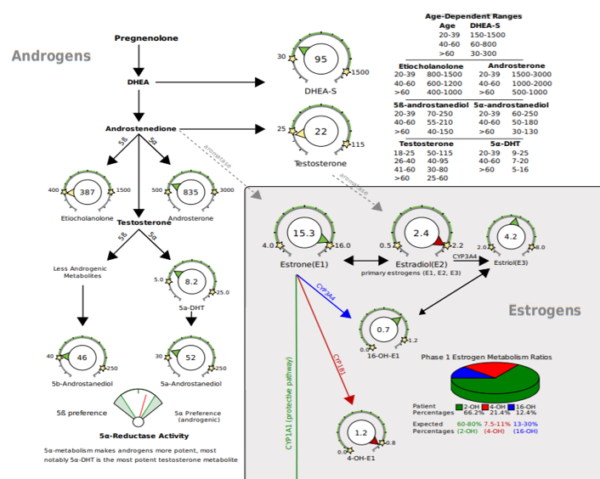
Measuring concentrations of metabolites of estradiol and progesterone in urine, instead of measuring serum concentrations, is common in research and also is used in patient care. The primary aim of this study was to demonstrate that analysis of urine samples dried on filter paper by gas chromatography with tandem mass spectrometry (GC–MS/MS) provides results similar to serum analyzed by radioimmunoassay (RIA). Secondary aims were to show that collection of four samples during the day (4-spot method) can be substituted for a 24-h collection, and that analysis of urine from dried samples is equivalent to liquid urine samples.
METHODS:
This prospective observational study compared results of urine and serum analyses. Urine samples from women throughout the menstrual cycle and single samples from postmenopausal women were evaluated. Urine was collected onto filter paper and dried. Dried urine was extracted, hydrolyzed, and derivatized prior to analysis by GC–MS/MS. Hormone concentrations were normalized to creatinine. Single samples were used to compare results of 24-h urine collection to the 4-spot method from a separate population of women and men. A subset of these samples were used to compare results from dried urine to liquid urine.
RESULTS:
The primary study showed good reliability in the comparisons between the dried urine and serum assays. During the menstrual cycles of a subset of four women, urine metabolite concentrations followed the same pattern as serum concentrations. Comparison of 4-spot to 24-h urine collections and of dried to liquid urine measurements had intraclass correlation coefficients (ICC) greater than 0.95, indicating excellent agreement.
CONCLUSIONS:
For estradiol and progesterone, the dried urine assay is a good surrogate for serum testing. The 4-spot method can be used instead of 24-h urine collections and dried urine results are comparable to liquid urine. The dried urine assay is useful for some clinical assessments of hormone disorders and may be useful in large epidemiologic studies due to ease of sample handling.
Source: https://bmcchem.biomedcentral.com/articles/10.1186/s13065-019-0539-1